
Nereid to Neráida: How Sea Nymphs Became Greek Fairies
The fifty daughters of the Old Man of the Sea left the water, moved into the mountains and became the fairies of Greek village life. Their name came with them.
4 min readThree words
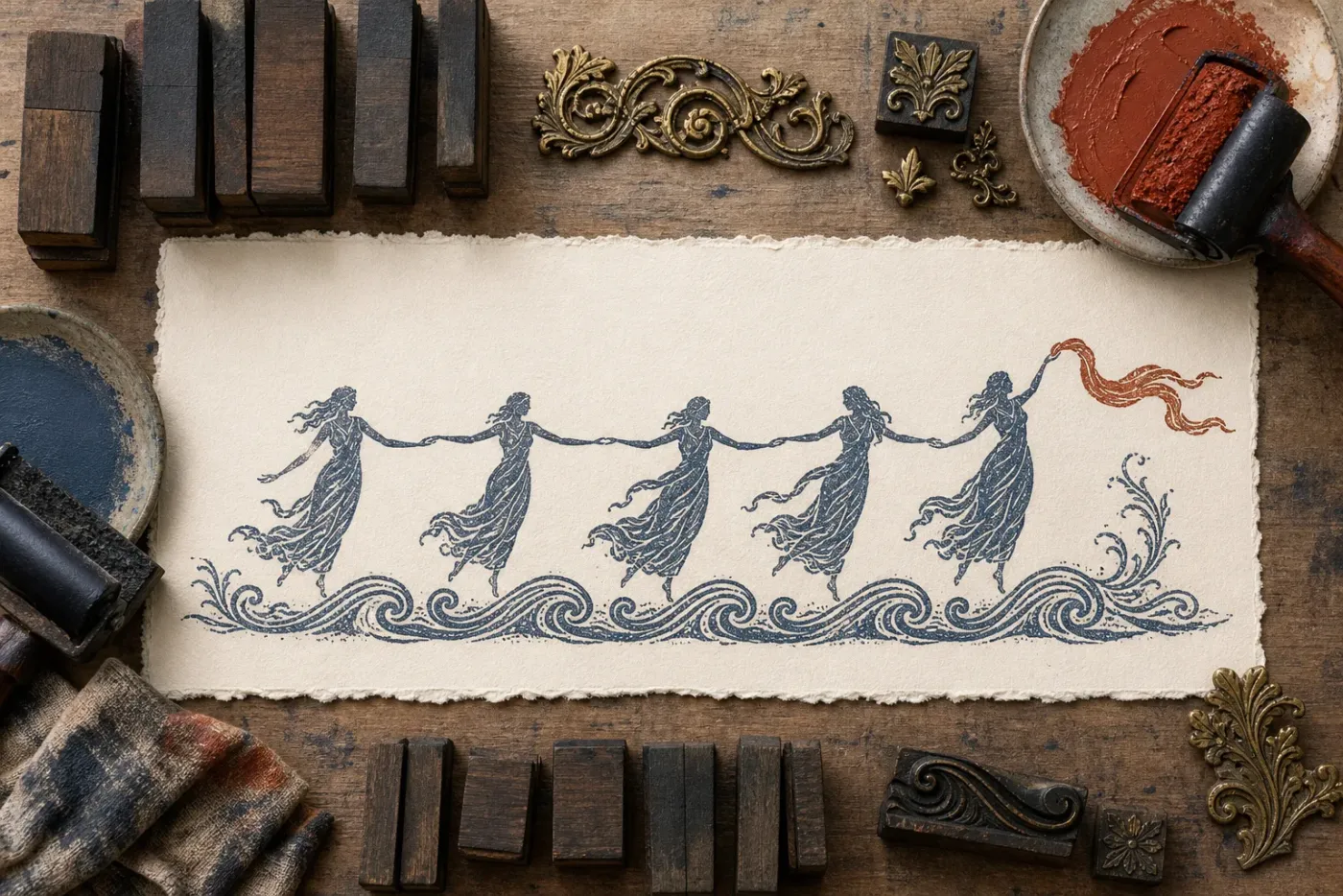
In the ancient world, the Nereids belonged to the sea. Hesiod lists them in the Theogony: fifty daughters of Nereus, the wise Old Man of the Sea, and the ocean nymph Doris, with names like Wave, Calm, Sandy and Swift. A few became famous in their own right. Thetis married a mortal and gave birth to Achilles; Amphitrite married Poseidon; Galatea was loved, hopelessly, by the Cyclops Polyphemus. In art, Nereids ride dolphins and sea horses through the waves. The English word nereid still means a sea nymph.
Then something remarkable happened. Over the centuries the word left the water and climbed inland.
The fairies of the village
In modern Greek, a neráida (plural neráides) is a fairy — not just of the sea, but of springs, rivers, caves, mountains, old trees and lonely threshing floors. Folklorists who listened to villagers in the nineteenth and early twentieth centuries, among them John Cuthbert Lawson, whose Modern Greek Folklore and Ancient Greek Religion appeared in 1910, recorded a consistent picture. Neráides are dazzlingly beautiful women dressed in white, who dance and sing in groups at night or in the stillness of noon. Their music is irresistible. Their attention is dangerous.
A person who stumbled on their dance might be struck dumb, lamed or driven out of their wits — the Greek word for such a person means, roughly, “seized by the neráides.” Mothers were warned against fetching water alone at the wrong hour. People preferred not to name the fairies directly and used polite euphemisms instead, such as “the good ladies.” And in a tale told in many versions, a young man could win a neráida as a wife by snatching her scarf or kerchief while she danced. She would live with him, bear his children and keep house — until the day she found the scarf again, when she would vanish, back to the dance, without a word.
nereid noun
- WordGreek Nērēis, “daughter of Nereus.”
- MythThe fifty sea nymphs listed by Hesiod.
- NowA sea nymph; a moon of Neptune; a family of marine worms.
neráida modern Greek
- WordThe descendant of ancient Nērēis.
- MythSea nymphs who became fairies of springs and mountains in folk belief.
- Now“Fairy”; also a compliment for a graceful, beautiful woman.
The water in the word
Here is the linguist’s puzzle. Modern Greek for water is neró, and it is hard not to hear it in neráida. The two words look like a family, and in a sense they became one. But neró has a separate history: it grew out of a Byzantine phrase for fresh water, nearon hydōr, literally “new water,” which was shortened to neró and gradually replaced the ancient word hydōr in everyday speech.
Most dictionaries trace neráida straight back to the ancient Nereids. Many scholars suspect that, once both words were in the language, the sound of neró helped reshape the fairy’s name and pulled her towards fresh water — towards springs and wells, where village women actually met her in stories. The two explanations are not rivals so much as layers: an ancient name, worn smooth and remodelled by a new word for water.
neró modern Greek
- WordFrom Byzantine nearon hydōr, “fresh water.”
- MythNone of its own — but it may have tugged the neráides towards springs.
- NowThe everyday Greek word for water.
Nereids in a telescope and a tide pool
English found its own new homes for the word. In 1949 the astronomer Gerard Kuiper discovered a small, distant moon of Neptune and named it Nereid, keeping the god’s family together in the sky. Marine biologists use Nereis as the name of a genus of bristle worms, the ragworms of muddy shores, and the family Nereididae takes its name from it. It is a strange fate for the daughters of the sea: a cold moon at the edge of the solar system, and a wriggling worm in a bucket of bait.
A word that kept its magic
What makes this chapter unusual is that the myth never stopped being believed in, in its own way. The Olympian gods turned into literature, but the neráides stayed in the landscape, attached to particular springs and caves, and they shaped how people behaved: when to fetch water, where not to sleep, which songs to avoid. Their name crossed nearly three thousand years from Hesiod’s catalogue to a grandmother’s warning, and changed its meaning along the way. That, in miniature, is what this whole book is about.
Notes and sources
- Hesiod, Theogony 240–264, trans. H. G. Evelyn-White (1914), via Perseus.
- J. C. Lawson, Modern Greek Folklore and Ancient Greek Religion (1910), chapter on Nereids; folk beliefs varied from region to region.
- The relationship between neráida and neró is discussed in standard etymological dictionaries of modern Greek; we summarize the usual view.