
Between Scylla and Charybdis: An Idiom With Teeth
Two monsters, one narrow strait and the oldest version of a dilemma we still describe in the same words. With a dog joke in the middle.
4 min readThree phrases
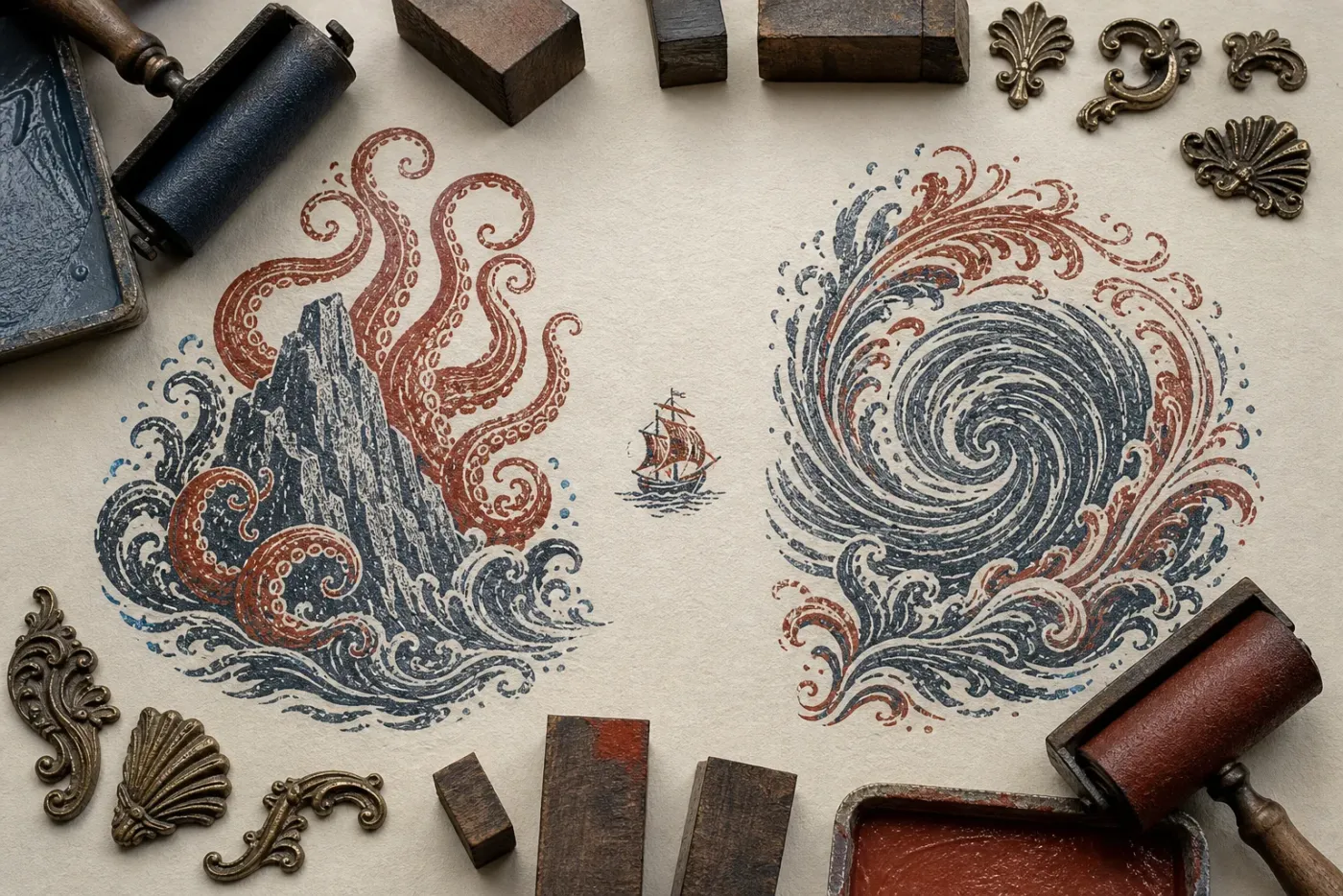
When you say you are caught between Scylla and Charybdis, you are quoting a piece of navigation advice. In Book 12 of the Odyssey, Circe gives Odysseus a sailing briefing for the next stage of his voyage. Past the Sirens, she says, the route runs between two cliffs. On one side, a cave high up the rock is home to Scylla. On the other, beneath a lower rock where a wild fig tree grows, lives Charybdis, who three times a day swallows the dark water and three times spews it up again. No ship caught in that whirlpool survives.
Scylla is the stuff of nightmares: twelve dangling feet, six long necks, six heads with three rows of teeth each, and the habit of plucking one sailor from a passing ship with every mouth. Circe’s advice is brutally practical. Hug Scylla’s cliff, she tells him; better to lose six men than the whole crew. Odysseus does exactly that, and Homer describes the six men being lifted away, calling his name. It is one of the darkest moments in the poem.
The dog in the name
Homer slips a joke into this horror. Scylla, he says, has a voice no louder than a newborn puppy’s. The Greek for a puppy or whelp is skylax, which sounds very like Skylla. Ancient readers caught the pun, and later artists took it literally, giving Scylla a ring of dogs’ heads around her waist. Whether the name really comes from skylax or Homer simply couldn’t resist the echo, nobody can say for certain. Charybdis is even more mysterious: no convincing etymology exists at all.
Later writers filled in her backstory. In Ovid’s Metamorphoses, Scylla was once a beautiful nymph. The sea god Glaucus loved her and asked Circe for a love potion; Circe, who wanted Glaucus for herself, poisoned the pool where Scylla bathed instead, and the nymph’s lower body sprouted barking dogs. Another monster who was a person first.
between Scylla and Charybdis idiom
- WordThe names of Homer’s two sea monsters.
- MythOdysseus steering through the narrow strait in Odyssey 12.
- NowCaught between two dangers, where avoiding one drives you towards the other.
A strait on the map
Ancient tradition placed the monsters in the Strait of Messina, the narrow channel between Sicily and the toe of Italy, where strong currents and eddies really can trouble small boats. A small town on the Calabrian shore is still called Scilla. Homer himself gives no map, and the identification came later, but it has proved remarkably durable.
From Homer to a proverb
The phrase became a proverb in Latin. In the twelfth century, the poet Walter of Châtillon wrote in his epic about Alexander the Great a line that circulated for centuries: incidis in Scyllam cupiens vitare Charybdim — you fall into Scylla in your eagerness to avoid Charybdis. Erasmus gathered the idea into his great sixteenth-century collection of proverbs, and from there it passed into the European languages as the standard learned way of describing a dilemma.
Notice, though, that the Latin proverb and the Homeric scene are not quite the same. Walter warns about overcorrecting: steer too hard away from one danger and you crash into the other. Circe’s advice is a calculation: choose the smaller certain loss over the larger possible one. Modern English uses the idiom for both, often without deciding which.
between a rock and a hard place idiom
- WordA plain-English phrase recorded in North America in the early twentieth century.
- MythNone; but it says exactly what the Greek monsters say.
- NowFacing two equally bad options.
entre le marteau et l’enclume French idiom
- Word“Between the hammer and the anvil.”
- MythNone; the smithy takes the place of the sea.
- NowSqueezed between two opposing forces, as in English “caught in the middle.”
The family of dilemmas
English has other ways to say the same thing. “Between the devil and the deep blue sea” has been in use since at least the seventeenth century. “Between a rock and a hard place” is younger and North American. French speakers in Quebec and elsewhere say entre le marteau et l’enclume, between the hammer and the anvil. All three are home-grown. Only “Scylla and Charybdis” asks you to know a story — which is why it sounds grander and lands harder when you use it. It has teeth, eighteen rows of them.
Notes and sources
- Homer, Odyssey 12.73–126 and 12.234–259, trans. Samuel Butler (1900) and A. T. Murray (1919), via Perseus.
- Ovid, Metamorphoses 13.898–14.74, trans. Brookes More (1922).
- Walter of Châtillon, Alexandreis (twelfth century), book 5; Erasmus, Adagia. Dates for the English idioms are approximate and follow standard dictionaries.